The complicated world of kids' online safety
WELCOME BACK TO THE MONTHLY FREE EDITION of Digital Politics. I'm Mark Scott, and will be splitting my time next week between Berlin and Brussels. If you're around and want to grab coffee, drop me a line.
— We're about to enter a new paradigm in how children use the internet. The global policy shift is a proxy for a wider battle over platforms' role in society.
— The European Union is shifting its approach to tech regulation. But these changes are not down to political rhetoric coming from the United States.
— How much would you sell your personal data for? France's privacy regulator figured out the sweet spot.
Let's get started:
WE'RE NOT IN KANSAS, ANYMORE
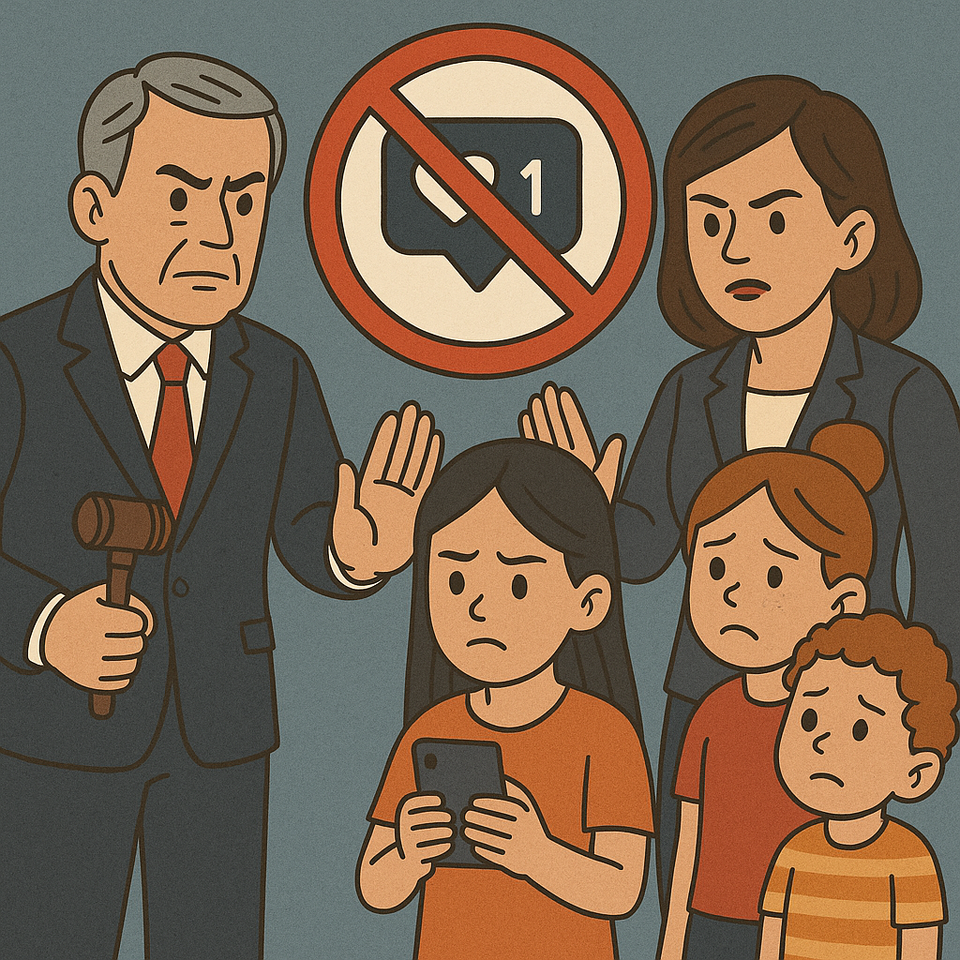
FOR THOSE INTERESTED IN KIDS ONLINE SAFETY, it's been a busy couple of weeks — and it's not slowing down. On Dec 10, Australia enacts its world-first social media ban (editor's note: Canberra calls it a 'postponement') for children under 16 years of age. On Dec 2, the US House of Representatives' subcommittee on commerce, manufacturing and trade debated 19 proposed bills to protect kids online. That includes a revamped Kids Online Safety Act, or KOSA, and the Reducing Exploitative Social Media Exposure for Teens Act, or RESET, that mirrors what Australia is about to enact.
In Europe, EU member countries just agreed to a joint position on how social media giants should handle suspected child online sexual abuse material. The biggest takeaway is officials' decision not to force these firms to automatically detect such illegal content on people's devices after privacy campaigners warned that would be akin to government surveillance. These national officials will now have to haggle a final agreement with both the European Commission and European Parliament before the long-awaited rules come into force.
To cap things off, the European Parliament passed a non-binding resolution to ban under-16s from accessing social media — a policy that everyone from Denmark to Malaysia is forging ahead with. US states from Texas to Missouri also have passed legislation requiring app stores to websites to verify that people are over 18-years-old before accessing potentially harmful content/services.
There's a lot of nuance to each of these moves. Much depends on the local context of each jurisdiction.
Globally, short-term attention will now focus on how Australia implements its social media ban (or postponement) on Dec 10. Tech firms say it'll cut children off from their friends online, as well as push them toward less safe areas of the internet that won't fall under the upcoming rules. Child rights advocates say Canberra's push to keep kids off social media until they turn 16 is a basic step after many of these platforms have been alleged to promote commercial interests over children's safety.
Here's what paid subscribers read in November:
— The EU's 'Jekyll and Hyde" tech strategy; The tech industry's impact on climate change has gone from bad to worse; The collective spend of tech lobbying in Brussels. More here.
— Here are the tech policy implications if/when the AI bubble bursts; What you need to know about Europe's rewrite of its digital rules; ChatGPT's relationship with publishers. More here.
— The European Commission's power grab at the heart of the bloc's Digital Omnibus; We should prepare for the end of an American-led internet; What devices do children use, and at what age? More here.
— The US' apathy toward its G20 presidency provides an opportunity for other countries to step up; Washington again wants to stop US states from passing AI rules; Internet freedoms worldwide have declined over the last 15 years. More here.
These policy battles are best framed around the unanswerable question of which fundamental right should take precedent: privacy or safety? As much as I believe some lawmakers' statements about protecting kids online are a cover for other political priorities (more on that below), it now feels inevitable we're heading toward a global digital age of majority in which some online goods/services will remain off-limits to those under a certain age.
For that to work, a lot will depend on how people's ages are checked online — and how such age verification does not lead to individuals' personal data leaking out into the wider world. Yet in the coming years, children will almost certainly live within a more curtailed online environment — though one that will still include significant harms.
But let's get back to those other political priorities.
First things first: everyone can agree that children should be protected, both online and offline. I would argue that all online users should have the same levels of protection now being rolled out for minors. That includes limits on who can interact with people online, bans on the most egregious data collection and usage, and safety-by-design principles baked into platforms currently designed to maximum engagement.
Many of those officials pushing for child-focus online safety rules, worldwide, would agree with that, too. They just are aware that such society-wide efforts to pare back the control, addictiveness and business models of social media giants are a current political dead-end due to the extensive lobbying from these firms to water down any legislative/regulatory efforts around online safety.
This is not just the state of play in the US where many of the world's largest social media platforms have embraced the White House's public aversion to online safety rules. From Canberra to Brasilia to Brussels, companies have successfully argued that such legislation can be an impediment to free speech and an unfair burden on commercial enterprises.
Even in countries that have passed such online safety rules, officials remain extremely cautious about taking a too hard line on companies, often preferring self- or co-regulation, as a first step, before rolling out aggressive enforcement.
That's why there's been a significant shift to focus on child-specific online safety rules worldwide. Yes, kids should be protected against harms more so than adults. But in framing legislation around the specifics of child rights, lawmakers can often sidestep accusations of censorship and/or overreach that would come if they attempted similar legislation for the whole of society.
I do not want to diminish the real-world harm that social media can pose to children. Nor do I think kids' online safety legislation should be put on the back burner until a consensus can be reached on how to oversee the platforms, more broadly.
But as we head toward the end of 2025, the disconnect between the growing number of online child safety efforts and the diminishing impetus (outside of a few countries) to tackle the society-wide impact of social media is hard to ignore. If lawmakers consider that data profiling, addictive recommender systems and online grooming — fueled by social media — are harmful to children, then why do they believe such practices are OK for adults?
Confronted with the current political reality, however, lawmakers have made the tactical decision to pare back expectations on passing comprehensive online safety rules to focus solely on online child safety. It's deemed as a safer political bet to pass some form of legislation whose protections, in a perfect world, would apply to both minors and adults, alike.
Chart of the week
IT'S BECOME A CLICHE TO SAY that because none of us pay for social media, then we — and our data — are actually the product (served up to advertisers).
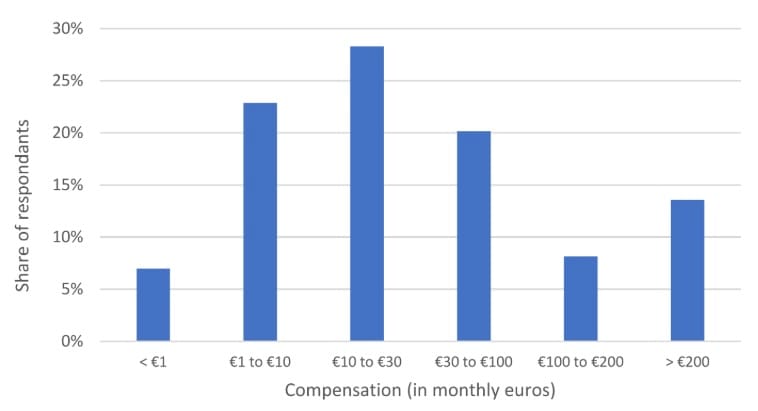
To figure out how much people would be willing to sell their personal information for, France's privacy regulator surveyed more than 2,000 locals about their attitudes toward what price they would be willing to accept for such sensitive information.
Roughly one-third of the respondents said they wouldn't sell their data at any price. But among the other two-thirds of individuals, the sweet spot fell somewhere between €10-€30, or $12-$35, a month.
What is really driving the transatlantic digital relationship
TWO SIGNIFICANT EVENT IN EU-US digital relations have occurred in the last 12 months.
First, the European Commission has embraced a deregulatory agenda spurred on by Mario Draghi's competitiveness report from 2024. This pullback was encapsulated by Brussels' recent so-called Digital Omnibus that proposed significant changes to the bloc's privacy and upcoming artificial intelligence rules. Here's me on why the revamp isn't as bad as many suspect.
Second, Donald Trump became the 47th president of the United States. Among his many White House executive orders, he took aim at global digital regulation from democratic allies, particularly those enacted in Europe, as well as pulling back on all rules (and international efforts) associated with AI governance.
The perceived wisdom is that these two digital geopolitical events are connected. That in its efforts to maintain security and economic ties to the US, the EU has thrown its digital rulebook under the bus to placate increasing criticism from Trump's administration and its allies in Congress.
This theory is wrong.
It's not that US officials aren't vocally lobbying their European counterparts to rethink the likes of the Artificial Intelligence Act, Digital Services Act and Digital Markets Act. They are — including US Commerce Secretary Howard Lutnik's recent comments in Brussels to that effect. (What many misremember is that such criticism, although less public, also came from Joe Biden's administration.)
But to make the binary connection between Washington's talking points and Brussels' digital policymaking rethink is to miss the complexities behind the current transatlantic relationship.
Even before the current European Commission took over in late 2024, there were signs that EU leaders wanted to press the pause button on new digital rules. Brussels passed a litany of new tech regulation in the previous five years. National leaders and executives from European companies increasingly questioned if such oversight was in the Continent's long-term economic interests.
Then came Draghi's competitiveness report, the comprehensive victory of the center-right (and pro-industry) European People's Party in the 2024 European Parliament elections and the return of Ursula von der Leyen as European Commission president, whose own interests in digital policymaking left a lot to be desired.
That tilted the scales significantly in favor of greater deregulation as Europe tried to bolster its sluggish economy, take advantage of AI advances and respond to European industry's claims that EU-wide digital regulation was hampering its ability to compete against US and Chinese rivals.
While that context has become mired in the geopolitics of Washington's seeming reduced support for Ukraine, the main driver for Brussels' about-turn on digital rules is internal, not external, political and economic pressure.
That takes us to Washington's aversion to digital regulation.
To be clear: this did not start with Trump 2.0. Throughout the Biden administration, US officials routinely scolded their European counterparts about hurting the economic interests of US tech companies. That came even as the former White House administration tried, unsuccessfully, to impose greater oversight on Silicon Valley via Congress.
Under the current White House, such criticism — and potential trade consequences — has been turned up to 11. But if you dig into how the Trump administration approaches tech regulation, much of the pushback against Europe is more performative than it may first appear.
On digital competition, it's arguable that the US Department of Justice is going further in its efforts to break up Big Tech than the European Commission and its Digital Markets Act. Yes, recent legal rulings may have hobbled American officials' efforts. But Washington remains a strong advocate for greater online market competition — even as federal officials side with Silicon Valley in their aversion to international ex ante regulation.
On platform governance, it's too easy to suggest US officials are wedded to First Amendment arguments as they criticize the EU's Digital Services Act. It's true that many misunderstand how that legislation actually works — in that it doesn't pass judgement on content, but instead reviews so-called systemic risks associated with how these platforms work.
But if you look at last year's request for information from the US Federal Trace Commission concerning alleged "platform censorship," then many of the points could be taken directly from Europe's online safety rulebook. That includes demands that social media giants explain how they make content moderation decisions, as well as provide greater redress for users who believe they have been hard done by. That's an almost word-for-word copy of what is currently available under the EU's Digital Services Act.
I'm not saying Trump's criticism has not played into the politics of Europe's digital rethink — including when certain enforcement decisions against Big Tech companies have been announced.
But it is just not true that Europe has caved in to American pressure when it comes to its digital policymaking u-turn. Instead, there are sufficient internal pressures — both economic and political — from across the 27-country bloc that are driving the current revamp.
As for Washington, it's less to do with officials' dislike for digital rulemaking, though one exception could be made for the White House's stance on artificial intelligence. For me, it's more to do with oversight of American companies originating from overseas — and not from Capitol Hill.
Within that context, it's best to view the current statements from the Trump administration less as "no regulation, ever," and more as "leave the oversight of US firms to American lawmakers."
What I'm reading
— The University of Amsterdam's DSA Observatory sketches out the current state of play for enforcement under the EU's online safety rules. More here.
— The United Kingdom's Ofcom regulator outlines non-binding rules for how online platforms should handle online harms against women and girls. More here.
— The White House published its so-called "Genesis Mission" to jumpstart the use of federal resources for AI-enable scientific research. More here.
— The European venture capital firm Atomico published its annual report on the state of the Continent's technology start-up technology industry. More here.
Member discussion