Sovereign AI: the timing problem
IT'S MONDAY, AND THIS IS DIGITAL POLITICS. I'm Mark Scott, and I'll be speaking at this Harvard University/IAPP digital conference in New England at the end of the month. If you're in Boston and want to meet, let me know here.
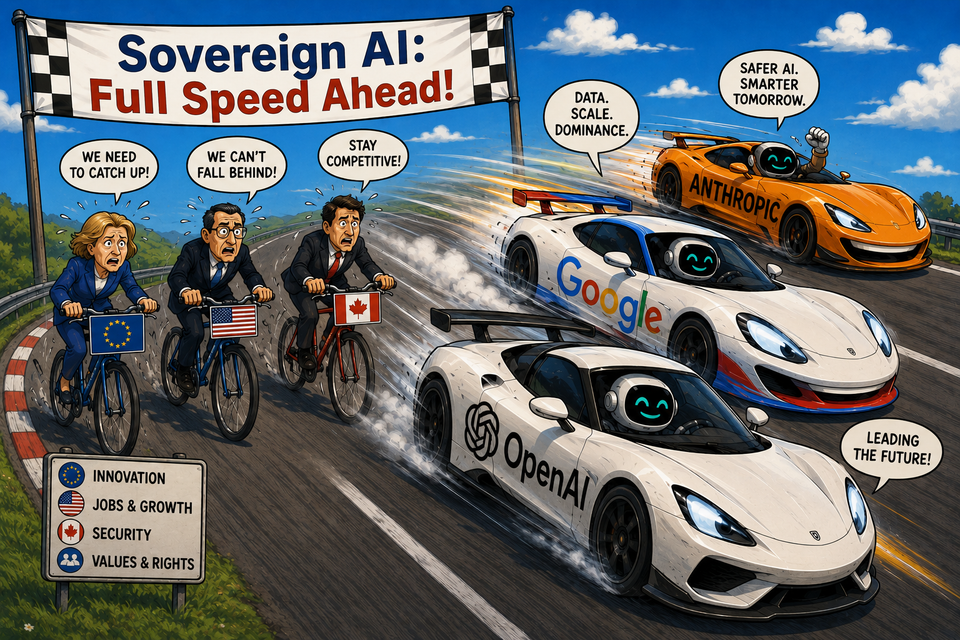
— The European Union, Canada and the United States outlined dueling visions for sovereign AI. None of them is keeping up with industry.
— Australia laid out a game plan for social media bans aimed at children. The country's early findings demonstrate the policy doesn't address the root cause of parents' anxieties.
— Two-thirds of future US data centers will be built in rural areas.
Let's get started:
Let the Sovereign AI competition begin!
THREE SEPARATE GOVERNMENT ANNOUNCEMENTS over three consecutive days. On June 2, the White House issued an executive order, mostly focused around AI and national security. A day later, the European Commission announced its long-awaited European Tech Sovereignty package, including new legislative proposals to jumpstart the Continent's cloud computing industry. On June 4, Canada unveiled its National AI Strategy — a document aimed specifically at boosting the country's sovereign ambitions around the emerging technology.
Taken together, it represents the most overt example of what countries have been doing, mostly tacitly, for at least 12 months. Where once the focus was on AI security and governance, national leaders have pivoted hard toward greater sovereignty and economic growth. Gone are the days where government announcements — even those from the US — centered on creating greater legislative safeguards around the emerging technology. We now live in an inherently geopolitical world, and countries are playing for keeps.
Each AI announcement framed this pivot in a different way. For Washington, the focus on national security played directly into what US policymakers believe is their competitive advantage. Almost all of the West's AI stack is currently based on American technology. Ensuring Silicon Valley stays the pre-eminent power in the era of AI is existential to the country's economic future.
"We will continue to lead an America First cybersecurity effort that enhances both our national security and our global AI dominance," read the executive order.
Europe's pitch was similarly geopolitical. Brussels pulled back from inserting "Buy European" commitments in how EU member states built out domestic cloud computing/AI infrastructure. But the message was clear: "We cannot afford to depend on others for the technologies that keep our hospitals running, our energy grids stable and our services secure," European Commission president Ursula von der Leyen, said in a statement.
Canada — the OG of the "Middle Powers" movement — similarly made explicit its need to go it alone on AI infrastructure. That would come via international partnerships, public investment in domestic AI compute power, and an AI literacy and jobs campaign aimed at generating $200 billion of economic growth by 2034. "AI that builds Canada strong for all: that is our mission," said Mark Carney, the Canadian prime minister.
There's just one problem with these announcements. They are policymaking efforts designed to tackle questions around AI — but built for an analogue world.