Postcard from Brussels: the digital vibe shift

WELCOME BACK TO THE FREE MONTHLY EDITION of Digital Politics. I'm Mark Scott, and the world appears to be veering out of control (again). You're here for digital policy. But for the latest on the evolving crisis in the Middle East, see here, here, here, here and here.
— The mood within European Union policymaking circles has markedly changed when it comes to digital sovereignty, online competition and platform governance.
— The likelihood of a digital-focused transatlantic trade war has risen significantly in the wake of the US Supreme Court's overturning of Donald Trump's tariff regime.
— Who's actually funding Europe's AI industry? The answer isn't who you would think.
Let's get started:
THE NEW REALITY OF THE BRUSSELS BUBBLE
THE EU QUARTER CAN BE A STRANGE PLACE. Among the glass-fronted European Commission buildings, the hustle and bustle of multilingual lobbyists and the cavalcade of European Parliament lawmakers that most people have never heard of, it's difficult to decipher fact from fiction. I've spent most of the last two weeks entrenched in the so-called Brussels bubble. I come bearing news: the EU's collective digital policymaking priorities are in flux — and a new reality is starting to emerge.
First, a caveat. This analysis is based on conversations before the US and Israeli attacks on Iran over the weekend. Such an open-ended conflict will inevitably change political priorities, including those associated with tech. I don't know how that will shake out. Reader discretion is advised.
What is unmistakable, however, is that three fundamental shifts are underway in how the 27-country bloc approaches digital policymaking. This shift is couched in 1) the deregulatory environment created by Mario Draghi's 2024 competitiveness report; 2) the dominance of the center-right European People's Party across all EU institutions; and 3) a relegation of tech-related issues behind those linked to Ukraine and trade.
First, the EU is implementing a version of digital sovereignty that will try to onshore infrastructure and seek to reduce the Continent's independence on US tech giants. This move began before Donald Trump's second term in the White House. But over the last 12 months, even staunch US allies in Eastern Europe and the Baltics have come to recognize that Washington can no longer be seen as a short-term trusted partner. That has jumpstarted a policy agenda aimed at investing public European money into local alternatives to gradually wean the bloc off US tech.
This is still an early-stage movement. Many within more defense-focused policy circles fret that a so-called "rip-and-replace" strategy, which would see the likes of AWS infrastructure give way to a European alternative, would create systemic vulnerabilities which would not be in EU member countries' short-term national interests. More fiscally hawkish officials also worry that throwing EU public funds at often legacy industrial players — many of which are the only ones currently positioned to offer alternatives to Silicon Valley — would not represent good value for money.
Here's what paid subscribers read in February:
— Digital policymaking needs a fundamental rethink; US attacks against Europe's online safety regime are not really about the bloc's online safety regime; Southeast Asia still dominates the world's semiconductor industry. More here.
— Public security and combating disinformation are increasingly intertwined, often in ways that should leave us feeling queasy; How Brussels' latest regulatory enforcement about TikTok plays into the EU's wider legislative agenda; Polarized social media has led to a public exodus from these platforms. More here.
— Be wary of anyone at India's AI Impact Summit peddling easy solutions for AI governance; The rise of kids' social media bans is example of the lack of quantifiable evidence in digital policymaking; The Global Majority is missing from the global data center boom. More here.
— What is, and what is not, working within the EU's Digital Services Act; Debrief from the AI Impact Summit: more trade show than policymaking; One-third of US teenagers use AI chatbots every day. More here.
And yet, my conversations with EU officials over the last two weeks made it clear that such a "Make Europe Great Again" digital sovereignty strategy — including now open discussions of funding European alternatives to American social media companies — has been baked into the bloc's policy priorities.
Second (and this is related to the first point) is a growing awareness and willingness to use the EU's digital competition rulebook to fast-track the newly-empowered digital sovereignty strategy.
While some officials and advocates would like to pour money into European alternatives (and that inevitably will happen), others are taking a more nuanced approach. That includes galvanizing the EU's Digital Markets Act to reduce market concentration which, in turn, would open up space for European alternatives to flourish.
This strategy is based on the somewhat naive belief that if only Big Tech didn't control the market, then a steady flow of European and non-European firms would be able to compete in everything from social media to online marketplaces to cloud computing infrastructure. Such a theory misunderstands the network effects from which consumers benefit when such services are bundled together — often at a cheaper price compared to buying such digital wares individually.
But as the DMA undergoes a current review, policymaking hope to extend the competition levers within this legislation to more aggressively hobble US tech firms, as well as expand areas of interoperability so that smaller firms can build on top of these platforms by offering people the ability to connect often rival services to each other. This is already available for messaging services within the bloc, and some EU startups now offer that ability.
Policymakers are also looking to extend that functionality — and, goes the theory, reduce Big Tech's market dominance and boost the bloc's digital sovereignty — to the likes of social media.
Third: the era of vigorous enforcement of the bloc's online safety and platform governance rules will be replaced by more nuanced policymaking aimed at balancing internal political priorities with those coming from outside the bloc.
That may sound odd, given my take on the EU's online safety landscape from last week. But the political winds have shifted away from comprehensive enforcement on topics like platform design and disinformation (editor's note: this does not constitute illegal content under the bloc's Digital Services Act). In its place, there will be more kneejerk policymaking attempts around populist topics like social media bans for teenagers, which meet short-term priorities for national leaders without addressing the long-term harm derived from how these platforms are designed.
It would be wrong to think that attacks from the US on the DSA had not played a role in this shift. The European Commission is a political beast. The repeated (and unfounded) claims that these rules equate to censorship of Americans' First Amendment rights have been heard at the very top of the Berlaymont building.
But, in truth, the shift away from aggressive, fast and comprehensive enforcement of the bloc's online safety rules has been driven by a change in the EU's internal dynamics.
Many center-right politicians — and such lawmakers now hold a majority in the European Commission, European Parliament and Council of the EU — are openly skeptical of the need for these rules. The complexities of implementing the DSA, in which Brussels enforcers are struggling to have a meaningful impact, have run up against shifting political priorities that promote deregulation and a more populist digital agenda.
That doesn't mean Brussels won't continue enforcing the DSA. But it is no longer first among legislative equals as EU officials turn their attention to digital sovereignty and the use of the bloc's competition rules to lift up European alternatives to their US and Chinese competitors.
Chart of the week
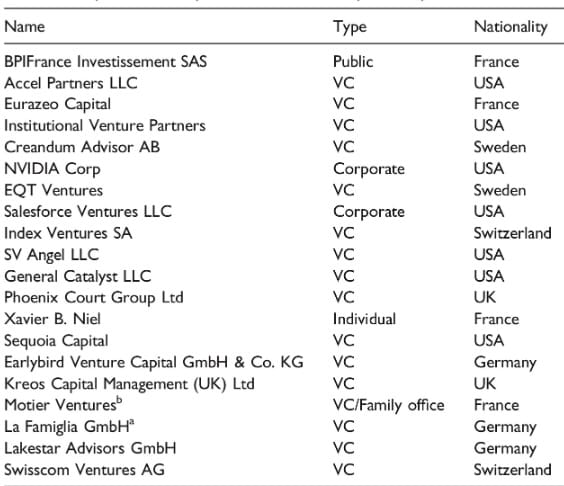
EUROPE WANTS TO GO IT ALONE ON AI. But which investors lie at the heart of the Continent's strategic ambitions for the emerging technology?
The University of Amsterdam's Leevi Saari crunched investment funds for all AI-linked European startups (including those from non-EU countries.) He then ranked which investors were central to these deals, ranking them on so-called "betweenness centrality," or a figure that measures the importance of certain actors in how the Continent's AI startups grow.
At the top of the list is French public investor BPI France, which plays a central role in the country's AI scene. Only one American Big Tech firm — Nvidia — makes the list (at number six.) Top-tier US venture capitalists and Europe's billionaire class, like Xavier Niel, also underpin how AI investment works across Europe, based on Saari's analysis.
ARE WE HEADING TOWARD A TRANSATLANTIC (DIGITAL) TRADE WAR?
THE RECENT US SUPREME COURT 6-3 DECISION to invalidate 60 percent of US tariffs against third-party countries feels like a lifetime ago. In truth, it only happened on Feb 20. The world is rightly preoccupied with other matters. But the ongoing global omnishambles should take away from the fact that the EU-US trade deal — known as the Turnberry Framework — is on life support after the European Parliament refused to ratify it; and US President Trump threatened a new round of potential tariffs, including those that targeted the 27-country bloc (more on that below).
Trade negotiators, on both sides, are seeking a compromise. Maroš Šefčovič, the EU's trade czar, held meetings with his US counterpart, and said that "full respect for the EU-US deal is paramount."
If only things were that simple.
I still believe that any future transatlantic trade beef would likely be limited to the offline, not online, world. The US runs a significant trade surplus with the EU on digital services, whereas it runs an almost identical trade deficit on non-digital goods. If Washington really wants to hurt Brussels (and other European capitals), then it makes a lot more sense to slap tariffs on French wine and German cars than it does to tax incoming digital services from the likes of <<checks notes>> almost no EU-based firm (I joke, but only just.)
This, however, is where things get sticky. As part of the White House's new arsenal of potential tariff measures are so-called Section 301 investigations. These probes allow the US Trade Representative to look into any country's trading practices to determine if they are discriminatory or unfair against US firms. When it comes to Europe, the Trump administration has already made clear its anger toward the bloc's digital rulebook.
"The European Union and certain EU Member States have persisted in a continuing course of discriminatory and harassing lawsuits, taxes, fines, and directives against U.S. service providers," the USTR said in late 2025. "If the EU and EU Member States insist on continuing to restrict, limit, and deter the competitiveness of U.S. service providers through discriminatory means, the United States will have no choice but to begin using every tool at its disposal to counter these unreasonable measures."
Shots fired, if you will.
There is still a long way to go before Washington starts specific 301 investigations into Europe — let alone before it leads to a tit-for-tat trade war with Washington. US President Trump, however, is looking for any opportunity to impose new tariffs. And for the EU, that's most likely connected to the bloc's competition laws, known as the Digital Markets Act, and national digital services taxes, which almost exclusively are paid by American tech firms.
That contrasts with the public attention focused by some in the White House against the bloc's online safety rules. Such ire may represent red meat in the ongoing culture war issue of platform governance. But for almost all US tech giants, the bigger issue remains EU digital competition rules and these unilateral digital services taxes.
If I was to be a betting man, I would put all my money on upcoming 301 investigations to focus on these two digital issues in how Washington responds to last month's US Supreme Court decision. Former administrations, on both sides of the aisle, have raised objections to these laws. Competition rules and digital services taxes would neatly fix into the definition required to start such investigations. And the focus on tech — compared to more analogue products — provides the White House with a strong corporate lobbying constituency willing to back a more aggressive stance with Europe.
For now, such speculation remains what it is: speculation. Officials' attention is also drawn elsewhere.
But in the coming months, I would wager the US will attempt to use such digital-focused 301 investigations to force the issue. In response, Europe already has a suite of tech-focused tariff responses that would be aimed at Silicon Valley — including potential hefty EU tariffs and, if things really go badly, potential Continent-wide bans on certain digital services.
Hopefully, we do not get to such a stage, for the sake of officials on both sides of the Atlantic. In the wake of the Turnberry deal (almost of which did not affect the digital world), most people breathed a sigh of relief that we had avoided a transatlantic trade war. That threat is now back — and all bets may soon be off.
What I'm reading
— Chatham House published an analysis into how so-called Middle Powers countries could navigate the dual hegemony of the US and China on AI. More here.
— A report from Citrini, a research group, into the potential labor force and market impact of mass adoption of AI led to a significant fall in US financial markets. Read the analysis here.
— We are living in a 'sovereignty paradox' in which the more governments and companies try to build their own AI systems, the more they rely on a small number of foreign providers, argues Damien Kopp for the Digital New Deal
— More than 60 data protection authorities from around the world signed a joint voluntary statement on the privacy impact on AI-generated imagery. More here.
— The US federal government ordered all agencies to stop using Anthropic's AI systems after it refused to meet certain commitments, including the use of its technology to surveil American citizens within the country and to power unmanned military equipment. Here is Anthropic's statement. And here is the statement from OpenAI's Sam Altman after the company agreed to work with the US Department of War.
Member discussion