Digital sovereignty: Hope versus reality
SUPPORTED BY
IT'S MONDAY, AND THIS IS DIGITAL POLITICS. I'm Mark Scott, and I'm not sure about you, but the concept of putting data centers in space — outlined by Elon Musk over the weekend via his so-called 'Terafab' project — doesn't feel like a top priority with all that's going on in the world.
— Europeans want to wean themselves off US tech. Many just don't think it's a realistic option, according to polling from YouGov.
— Social media is awash with AI-generated content about the US/Israeli-Iran conflict. Companies need to do better at flagging and removing these posts.
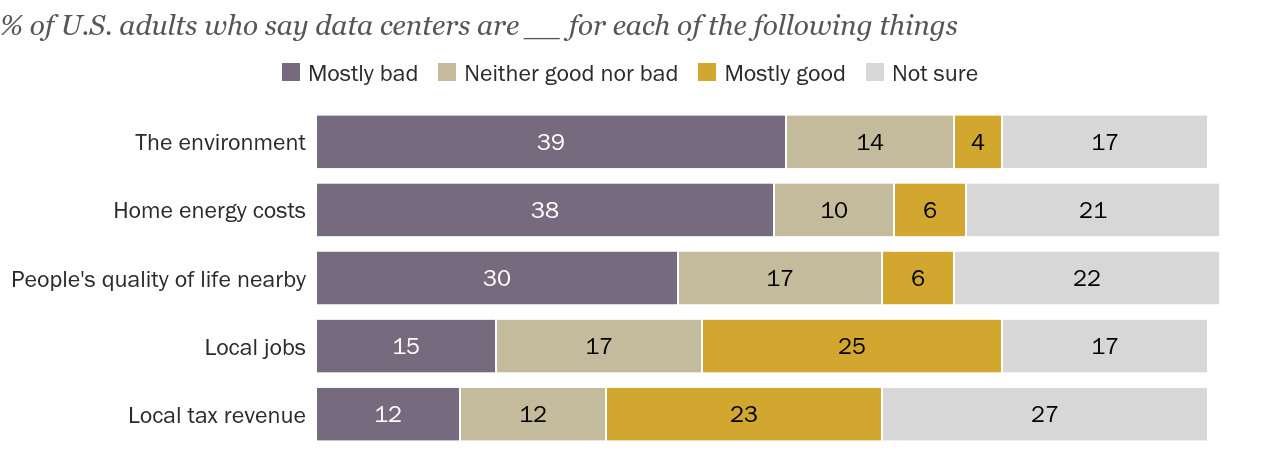
— About 20 percent of Americans have yet to make up their mind about how data centers will affect their daily lives.
Let's get started:
THE UNCOMFORTABLE TRUTH FOR EUROPE'S DIGITAL SOVEREIGNTY AMBITIONS
THERE'S A NEW VIBE TAKING SHAPE IN MANY European capitals when it comes to digital sovereignty. Once it was mostly French officials that spoke of decoupling from the likes of Amazon and Google. Now, policymakers and politicians in other European Union countries openly talk about paring back dependencies on companies that are perceived (rightly or wrongly) to be leaning too much into current United States foreign policy.
That comes in the form of national governments, like the Netherland's newly-formed coalition, seeking to replace services from Silicon Valley with those from European/national competitors. It comes in the form of billions of dollars of EU taxpayers' money earmarked for Continent-wide AI infrastructure to boost economic growth — albeit almost all of this hardware is powered by US-designed chips. It comes in the form of nascent projects like the Eurosky social media network, whose tagline is "Hosted in Europe, governed in Europe."
Taken together, it represents a hardening of political resolve (though mostly in Western European countries) at a time of deteriorating transatlantic relations, an increase in geopolitical competition around artificial intelligence, and unanswered questions about who should ultimately control the digital services upon which we all now rely.
Yet is such policymaking chatter matched by what the average European believes? That's a fundamental question that often goes unanswered. So I teamed up again with YouGov, the polling company, to find out.
**A message from Meta** On 24 March, Meta, with eco and EssilorLuxottica as supporting partners, will host The Brussels AI Symposium featuring European Parliament President Roberta Metsola, US Ambassador to the European Union Andrew Puzder and some of Europe’s foremost innovators. Does Europe have what it takes to seize the AI opportunity? Learn more here. **
In early March, the firm ran a series of digital sovereignty questions across the EU's largest countries, by population. That includes Spain, Germany, France, Italy, and Poland, respectively. The survey covered just over 1,000 respondents per jurisdiction. The questions focused on 1) Which digital services these individuals currently used, and where these companies were headquartered; 2) Whether people had considered switching from US to European options; 3) If respondents thought it would be a good idea to shift toward EU alternatives; and 4) Was such a "rip-and-replace" strategy realistic?
I come bearing both good news and bad news — for either side of the digital sovereignty debate.
Let's start off with the current vibe among Europe's largest countries.
Overall, roughly 62 percent of those surveyed said it was a good idea for both European governments and businesses to replace US data storage, video conferencing and digital payment systems with those headquartered in the 27-country bloc. (See chart below). Italy had the highest level of support (67 percent), followed by Germany (65 percent); Spain (64 percent); and France (58 percent).
One point of caution. There was a significant difference between the four Western European countries and Poland. In the Eastern European country, only 49 percent of respondents said it was a good idea — highlighting a reticence to give up American tech services in a country whose population remains more aligned with the US compared to other EU countries. Interestingly, though, 38 percent of Poles responded "don't know" to YouGov's question. That means a sizable minority had yet to make up their mind (or weren't clued up on the issue to pass judgement.)
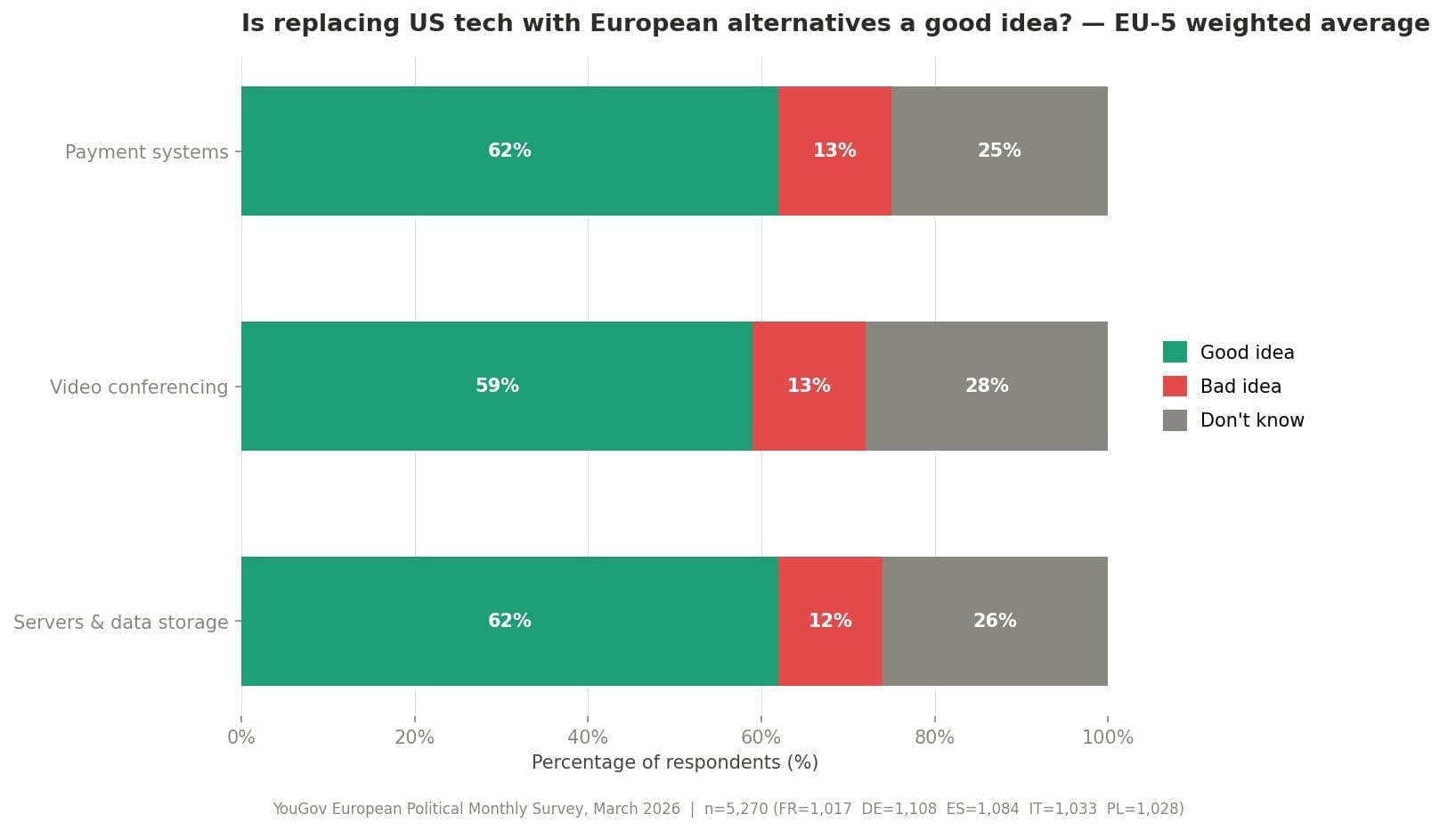
So that's the case for the prosecution. A significant percent of citizens in Europe's largest countries, by population, support digital policymaking to replace American tech with European alternatives. Job done. Case closed.
And yet.
YouGov then asked a follow-up question: how realistic was it for European governments and businesses to replace US digital services with those from Europe? This goes directly to the vibe question. People may want greater digital sovereignty. But do they think it's achievable?
That's where the pendulum shifted away from Europe's more muscular policymaking. Overall, 41 percent of respondents across all 5 countries said it would not be realistic to go "full European" when it came to digital services. That compared with 40 percent of people who said it was realistic, and a further 19 percent of poll respondents who didn't know.
Again, the country-by-country differences (see chart below) were illustrative. In Germany, Europe's largest economy, skepticism about replacing US tech ran at 51 percent. In France and Poland, that figure fell to 32 percent, respectively, while over 40 percent of respondents in each country said it would be realistic to shift from American providers to those from the bloc.
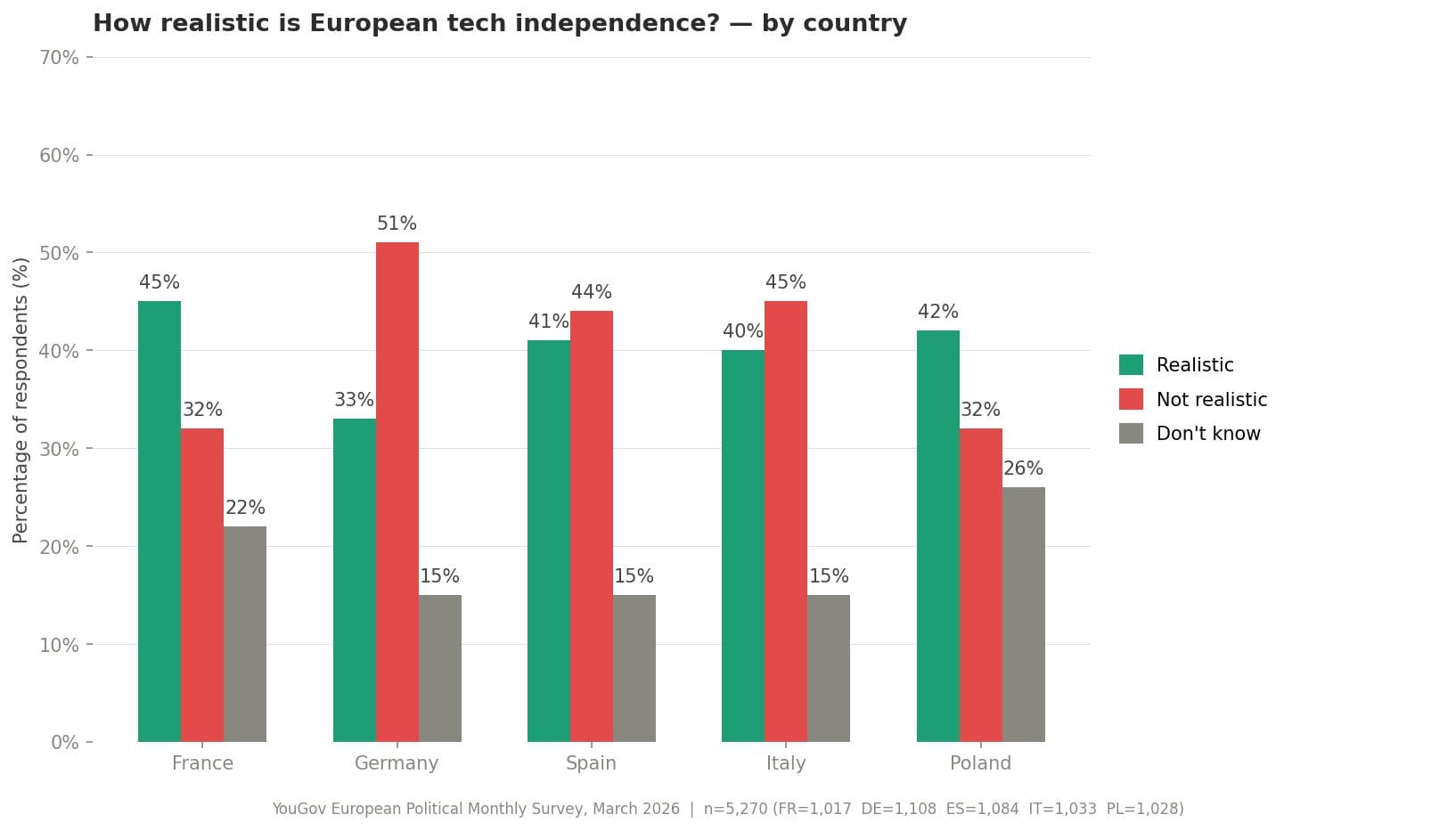
This skepticism — in which 41 percent of those surveyed said they didn't believe a digital replacement strategy for US tech was realistic — should raise red flags for EU leaders now openly calling for such a move. Yes, 40 percent of respondents said this US-to-Europe tech shift was possible. But when the majority (albeit only just) don't think it's achievable, you run into a perception gap that needs to be filled before pushing ahead with a potentially generational change in the types of digital services across the Continent.
Another point was important via YouGov's polling. Roughly a quarter of people in all five countries didn't know whether it was a good idea or realistic to change from US to European services. That represented a significant education gap between policymakers and citizens, about 25 percent of which were not sufficiently aware of the issues to make a judgement via the Continent-wide survey.
Let's give an example of why this is a problem.
France currently wants to replace US videoconferencing services like Zoom and Microsoft's Teams with local alternatives by 2027, in part for digital sovereignty reasons. Yet when asked about this policy via YouGov's survey, 89 percent of French respondents had heard little or nothing about the proposals. That's a failure on the part of Paris to communicate about why it was pursuing a "Made in France" strategy with a population, at least on paper, open to shifting toward more European tech services.
This "I don't know" minority is where the real battle around digital sovereignty resides. Yes, the most digital-literate citizens (some of whom, I'm presuming, are reading this newsletter) already know which side of the debate they are on. Those positions are entrenched. Yet the one-in-four Europeans who have yet to make up their mind are likely open to persuasion — either for/against a shift away from US tech.
That represents a policy communication challenge for European lawmakers, as well as US/EU tech firms seeking to peddle their wares across the Continent. Whoever can convince the 25 percent of the 27-country bloc's citizens that it's a good or bad idea to reduce the Continent's current dependence on US tech will likely carry the day in the battle around digital sovereignty.
Chart of the Week
IN CASE YOU HAD MISSED IT, there's a data center boom underway across the US. As tech giants vie for AI dominance, they are building out this energy-hungry infrastructure faster than you can say 'large language model.'
But a significant percentage of Americans have yet to make up their mind if these data centers are good for them, the economy, and the environment, respectively.
Across five areas that the Pew Research Center polled earlier this year, around one-in-five Americans were not sure on the impact of this fast-growing AI-enabling infrastructure.
AI SLOP AND THE FOG OF WAR
ON THE EVE OF THE TWO-YEAR ANNIVERSARY of Hamas militants attacking Israel in 2023, I wrote this about how social media companies were not doing enough to protect users from war-related content, propaganda and illegal content. That was as true for the Israeli-Hamas conflict as it was for the more than 60 other active state-based war zones worldwide.
Fast forward five months, and this problem has been turned up to 11 in the ongoing Middle East conflict. AI-generated videos and images — either depicting attacks against Iran, Israel or other parts of the Middle East — are rife on the likes of X, Facebook, and Instagram. Some of this AI-powered content comes from official government sources (including from the White House's social media accounts.) Other material is created by click-bait merchants seeking to monetize people's views via online advertising.
But beyond why people are posting such AI-generated material, the key question is how social media giants — all of which are using their own large language models to oversee what is posted on these global networks — are failing to catch what is now an avalanche of AI slop directed at the ongoing war in the Middle East.
This was not how it was supposed to be.
**A message from Meta** On 24 March, Meta with eco — the Association of the Internet Industry — and EssilorLuxottica as supporting partners, will host The Brussels AI Symposium.
The event will feature European Parliament President Roberta Metsola, Andrew Puzder, US Ambassador to the European Union and leading European innovators to discuss what it takes for Europe to seize the AI opportunity. The Symposium serves as a critical conversation about how Europe can foster innovation and build on its strengths. Learn more about the event here.
Two years ago, many of these tech firms committed themselves to (albeit voluntary) standards known as the AI Election Accords. Yes, these pledges were linked to that year's election-palooza worldwide. But companies from X and OpenAI to Anthropic to Google said they would develop/implement tech to "mitigate risks" related to deceptive AI election content; find and address such content on their platforms; and provide greater transparency to the public about how they went about those efforts.
A lot has changed between 2024 and 2026. These (again, voluntary) commitments were also specifically drafted around elections, not conflicts. But the pledges should be taken as a benchmark for company commitments to combat AI-generated harmful content — be that related to how people vote or how state-based conflicts play out worldwide.
On those markers, the companies are failing.
There are multiple reasons why, and it's not all down to a failure of social media giants to effectively police their networks.
The ability to produce lifelike AI slop is a lot better, in March 2026, than it was in February, 2024 when the AI Election Accords were signed. The use of such techniques by state-based actors also complicates responses for companies seeking to navigate the increasingly complex geopolitical world of digital policymaking. The sheer volume of AI-powered posts — which, collectively, have garnered hundreds of millions of views across all platforms related to the most-recent Middle East conflict — makes any comprehensive response a mere whack-a-mole operation.
But it's also true that tech firms are not doing enough.
After AI-generated fake conflict videos went viral on X, for instance, the company said it would suspend any account involved in such dissemination from its creator revenue sharing program for 90 days. "This will be flagged to us by any post with a Community Note or if the content contains meta data (or other signals) from generative AI tools," Nikita Bier, the company's head of product, wrote on X. That's a slap on the wrist for content that, at its worst, can foment sectarianism and offline attacks in what is already an incredibly hostile environment.
Then there's Meta. On March 10, the Oversight Board, or group of outside experts (which, to be clear, is funded by the tech giant) posted recommendations on how the company should handle "deceptive AI during conflicts." The suggestions — which, under the Oversight Board structure, are only voluntary — were linked to a binding ruling on Meta related to an AI-generated post during last summer's 12-day conflict between Israel and Iran.
Back story on that ruling: a video posted on Facebook depicted significant damage to an Israeli city. It garnered more than 700,000 views despite a fact-checking organization debunking the content (via an identical post on TikTok) as AI-generated. Several Facebook users appealed to Meta for the post to be removed. The company, however, said the content didn't violate its policies, and it didn't require a label saying the video was AI generated.
The Oversight Board said this month that the decision was wrong. Meta said it would comply with that ruling (but only on that individual post, per the outside group's mandate) within 7 days.
"Social media platforms need to provide automated, technical and human-led solutions to limit harmful impacts of AI content intended to deceive, while upholding people’s freedom of expression," said the Oversight Board. Its recommendations included: 1) improved standards for determining how all online content was created; 2) new tools to detect AI-generated material; 3) greater human content moderation, including the use of outside fact-checkers and internal trust and safety teams.
At a time of corporate retrenchment from such activities (and not just from Meta), such recommendations will likely fall on deaf ears. Conflict-driven AI slop will continue to go viral — even as social media giants try, often with reduced resources, to combat it.
As the Middle East conflict rages on, social media increasingly is not a trusted place to understand what is going on in the world (editor's note: for that, read newspapers.) People are confused about what they see online. They often can not legitimately tell the difference between what is real and what is imagined. Without a significant rethink of how that trust can be rebuilt, the utility of social media as a source for news (more than 50 percent of Americans still use it for that purpose) is now in question.
What I'm reading:
— If you're wondering about my sponsorship policy, please check out my advertising ethics statement here. Get in touch on digitalpolitics@protonmail.com if you have questions.
— Courtney Radsch explains the political pressures coming from the White House on Europe's attempts to implement its online safety regime. More here.
— The European Democracy Shield centralizes control, maintains officials' gatekeeping powers and institutionalizes a top-down approach to media literacy, according to Paul McCarthy for the Heritage Foundation.
— The level of democracy across Western Europe and North America is at its lowest level in over 50 years, primarily due to autocratic tendencies in the US, based on an annual survey from Varieties of Democracy.
— The Christchurch Call Foundation published results of a survey into how best to study social media algorithms and the dissemination of terrorist and violent extremist content. More here.
— As the United Kingdom mulls a potential kids social media ban, the country's online safety regulator reminded tech firms of their obligations to keep children under 13-years-old off their platforms. More here.
Member discussion