Tech policy is now industrial policy
WELCOME BACK TO THE FREE MONTHLY EDITION of Digital Politics. I'm Mark Scott, and will be in Amsterdam and Brussels during the week of Feb 16, and then back in Brussels the week of Feb 23. If you're around for coffee, drop me a line here.
Also, apologies to those of you who are struggling to access the web version of this newsletter. There are ongoing technical difficulties linked with Ghost's back-end infrastructure. I'm working to resolve this asap.
— What defines digital policymaking is fundamentally shifting from a focus on online issues to those that directly affect the offline world.
— American lawmakers are again debating if Europe's online safety rules threaten the First Amendment. What is actually going on here?
— The world's semiconductor market remains highly concentrated within East Asia.
Let's get started:
THE END OF TECH POLICY AS WE KNOW IT
FOR YEARS, YOU COULD DIVIDE DIGITAL POLICYMAKING into three main camps. There was antitrust, privacy and platform governance. Some would argue that artificial intelligence deserves its own bucket. But, for me, AI fitted neatly into one of the three existing dogmas that underpinned decades of governance efforts linked to the online world.
That era is now over.
It's not that antitrust, privacy and platform governance, as topics, are either "solved" or relegated to the trash heap of history. If anything, these policymaking topics are now more pressing, in 2026, than at any other time in history. Yet it is time for those of us enmeshed in this world to acknowledge what has been on a slow burn for at least the last decade. Now, tech policy is as much an industrial policy issue — with all the political ramifications that come with that — as it is something that merely affects (and I say this with a pinch of salt) people and their interactions with some of the largest companies on earth.
By industrial policy issue, I mean the offline-online nexus of topics that encompass everything from the climate change problems and employment issues connected to data centres to the high politics of semiconductor subsidies and global tariffs imposed on electric vehicles. These topics significantly expand from the "antitrust, privacy and platform governance" cocoon that many of us, including myself, have lived in as the world has woken up to the fact that what happens online inevitably has consequences for the offline world.
There are many reasons for this shift.
In part, policymakers are fickle beasts, and the rise of semiconductors, large language models and "digital sovereignty" has allowed many to expand their interests from often wonky digital policy topics to those that have a more direct effect on the world around them.
Here's what paid subscribers read in January:
— Why the decline of US tech leadership, the rise of China as an internet governor, the growth of AI slop around elections, and the implications of child online safety rules will define 2026. More here.
— Europe wants to revamp its digital rules. Its citizens aren't so sure; Washington's departure from more than 60 international organizations shows how US officials are tactically engaging with global digital issues; Who dominates the world of data centers. More here.
— The transatlantic digital relationship has gone from bad to worse; Everything you need to know about India's AI Impact Summit; How many teenagers' social media accounts have been removed in Australia. More here.
— After Greenland-Gate, Europe is taking the gloves off when it comes to digital sovereignty; ByteDance's sale of its US TikTok unit doesn't solve any of the underlying problems; Teenagers are more open to smartphone bans than you might think. More here.
It's also true that many of the global efforts to update antitrust, privacy and platform governance rules — from the United States and European Union to Brazil and South Africa — have only had middling success. Some of that is down to policymaking being, well, hard. But the increasing geopolitical consequences (see the next section on the EU-US platform spat) of these decisions have often made actual legislating hard. Even those who have passed laws (looking at you, Brussels) must live with the reality that not all of their revamped digital rulebook has been the success that many had first hoped for.
National leaders have similarly embraced this "industrialization" of tech policy with open arms.
Being seen to open a new semiconductor foundry or data center is just better retail politics, in the short term, compared to the hard yakka required to pass child safety rules or unpick the oligopoly of a small number of Silicon Valley giants. It's not that some (but not all) lawmakers want to do those things. But it's an easier lift to return to political form via tax incentives and other subsidies to entice foreign firms to set up locally than to build complex coalitions to update national data protection regulation that few people actually understand.
I don't mean to denigrate this shift. The world is seeking economic growth — often powered by artificial intelligence. Politicians and policymakers face hard trade-offs between updating national economies to meet these new demands and supporting the more traditional digital wonkery which has defined the last 12 years of my career.
It's also true you can have both tech-driven industrial policy and digital policy that focuses on antitrust, privacy and platform governance. But what is becoming clear in 2026 is that many policymakers are shifting toward the former and away from the latter. That will require a recalibration for many (again, including myself) who feel more comfortable discussing the inner workings of ex ante digital competition reforms than how best to construct a federated system of data centres with the least energy footprint possible.
It's a mind-shift from almost exclusively focusing on the online world — often with offline consequences — to acknowledging that tech-focused industrial policy includes a greater number of traditional "analogue" policy areas than many of us have been used to dealing with.
That includes a heavy dose of trade policy as the world hurtles toward a zero-sum, mercantilist viewpoint where re-shoring, export controls and subsidies tied to foreign direct investment are as important as whether social media companies are held accountable for what is posted within their global networks.
It also includes a mishmash of policymaking specialisms that combines digital policy with labor policy with climate change policy with public health policy with a myriad of other policy areas which all intersect in this expanded form of tech-related industrial policy. Such coalitions are hard to create. Everyone believes their subject area is the most important and, routinely, experts speak past each other in jargon that no one outside of these communities understands.
None of this should take focus away from the ongoing problems associated with antitrust, privacy and platform governance. If Digital Politics can be read as anything, it's an indictment that within those three areas, there is still a lot of work to do.
But we should not remain siloed into what is comfortable and overlook what is happening around us. National leaders — mostly spurred on by the AI hype — are wedded to this blending of tech and industrial policy in the name of economic growth. That will have knock-on consequences beyond the digital realm, especially as the global labor force tries to navigate the complexities of the current techno-enabled geopolitical uncertainty.
Just like in last week's newsletter on the more muscular approach to digital sovereignty, within Europe, after the Greenland crisis, I do not yet have solutions to much of the complexity outlined above. It's going to be hard. But pretending that tech policy has not morphed into something more offline, more industrial and more multi-disciplinary would be a mistake.
It's time for many of us to evolve to meet this new challenge.
Chart of the Week
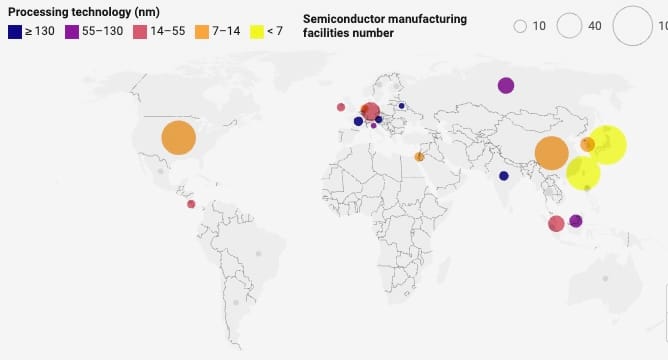
NOT ALL SEMICONDUCTORS ARE CREATED equally. But in terms of total production, three regions — East Asia, the US and the EU — represented more than 90 percent of the collective global annual production, based on figures from 2024, the last full-year available.
Even that geographical breakdown doesn't tell the full story.
East Asia, as a region, produces roughly three-fourths of the world's microchips. Within that, Taiwan manufactures 60 percent of total global semiconductor production — a figure that rises to 90 percent for the most advanced chips.
THE US TO EUROPE'S ONLINE SAFETY RULES: I JUST CAN'T QUIT YOU
YOU HAVE TO HAND IT TO CONGRESS. They may not be able to pass any digital rules (with maybe the exception of ByteDance's TikTok US offloading), but they sure like a hearing about how Europe is censoring Americans online. On Feb 4, the House of Representatives' Judiciary Committee will hold its second hearing entitled "Europe's Threat to American Speech and Innovation: Part II." Watch along here at 10am ET / 4pm CET / 3pm UK. You can read a report Republican lawmakers published to outline their arguments here.
The hearing follows a similar meeting, in September, which included British politician Nigel Farage comparing the United Kingdom to North Korea — because of the country's online safety regime, known as the Online Safety Act (editor's note: the UK is not like North Korea.) David Kaye, a University of California professor who gave evidence at the invitation of the Democrats, suggested it was the US, not Europe, that was undermining free speech.
Some US politicians and influencers' aversion to European online safety rules are well known. Accusations include subverting Americans' free speech rights; forcing platforms to crack down on legal speech online; and working with outside researchers to demote most right-wing social media users due to an alleged woke agenda. For more on what this looks like on the ground, check out my dispatch from 2023.
First things first: Europe's online safety rules are not about quelling free speech rights. Both the EU's Digital Services Act and UK's Online Safety Act enshrine protections for free speech into each separate legislation. (Disclaimer: I sit on an independent committee at Ofcom, the British regulator which oversees the country's rules, and anything I say here is in a personal capacity.) At their roots, these online safety regimes are exercises in transparency which are aimed at holding social media companies to their word on how they implement internal terms of service.
If these companies don't follow mostly internal procedures — or, in the case of X, flagrantly disregard basic transparency requirements — then they will be held responsible for those actions. Such regulatory oversight is standard in sectors from financial services to pharmaceuticals. X is appealing its fine under the EU's Digital Services Act.
Many European officials believe they can win over American critics by explaining the basics of how these regimes operate. If only we can make them understand the inner workings of mandatory risk assessment and audit requirements, goes the theory, then they will realize that no one wants to harm free speech.
That framing misses the point.
If this was about the specifics of these online safety rules, then it would be obvious — based on the actual reading of the documents (here and here) — that censorship is not at the heart of this legislation. Or, if you don't want to scroll through those pages, read this from the European rules:
"Providers of intermediary services shall act in a diligent, objective and proportionate manner in applying and enforcing the restrictions referred to in paragraph 1, with due regard to the rights and legitimate interests of all parties involved, including the fundamental rights of the recipients of the service, such as the freedom of expression, freedom and pluralism of the media, and other fundamental rights and freedoms as enshrined in the Charter." (Emphasis in bold is my own)
But if you read these American criticisms as part of a decades-old attempt to hobble Europe from regulating US tech firms — in everything from antitrust, privacy and platform governance (see above section) — then these latest attacks on the Old World's online safety rules start to make sense.
It's not specifically about which article within the UK's Online Safety Act is alleged to silence Americans within the US (note: there are none.) Instead, it's part of an ongoing effort — albeit one on steroids — that includes many US politicians and policymakers pushing back against European concerns that American tech giants may not be playing fairly when operating on the other side of the Atlantic.
That goes for everything from Silicon Valley's alleged weaponization of EU privacy rules to cement their dominance to ongoing claims that American social media companies are not transparent about what often polarising posts show up in Europeans' feeds.
It's notable that in the Feb 4 hearing in Washington, another topic under discussion is how the EU's Digital Markets Act and other corporate transparency rules "target American companies and hurt innovation." It's hard to square how criticism aimed at Europe's online safety rules should go hand in hand with complaints about the Continent's digital competition rules. Unless, that is, you view these discussions as part of the wider — and decades-old — pushback from Washington against Brussels' (and, to a lesser degree London's) attempt to hold some of the US' largest firms to account.
None of that excuses the ongoing attacks aimed at destroying the EU and UK's online safety rules — all in the name of protecting American free speech. Such rhetoric from some in the US has arguably made the European online information space more dangerous and harmful, in part due to companies' willingness to pull back on their online safety protocols to align with such American criticism.
What I'm reading
— A tech entrepreneur set up a Reddit-style social media that only AI agents could post to. Humans are relegated to just watching along. Check it out here.
— The European Commission open two proceedings into Google's obligations under the Digital MarketS Act. More here.
— The Netherlands is moving toward ditching US tech services for those created either domestically or within the EU. More here.
— Maldita, the Spanish fact-checker, found more than 500 TikTok accounts that produced AI-generated videos of alleged political protests in violation of its commitments under the EU's online safety regime. More here.
— The Irish regulator in charge of the EU's Digital Services Act published guidance on how independent researchers could apply for access to private data held within social media companies. More here.
Member discussion