The global battle for AI, revisited
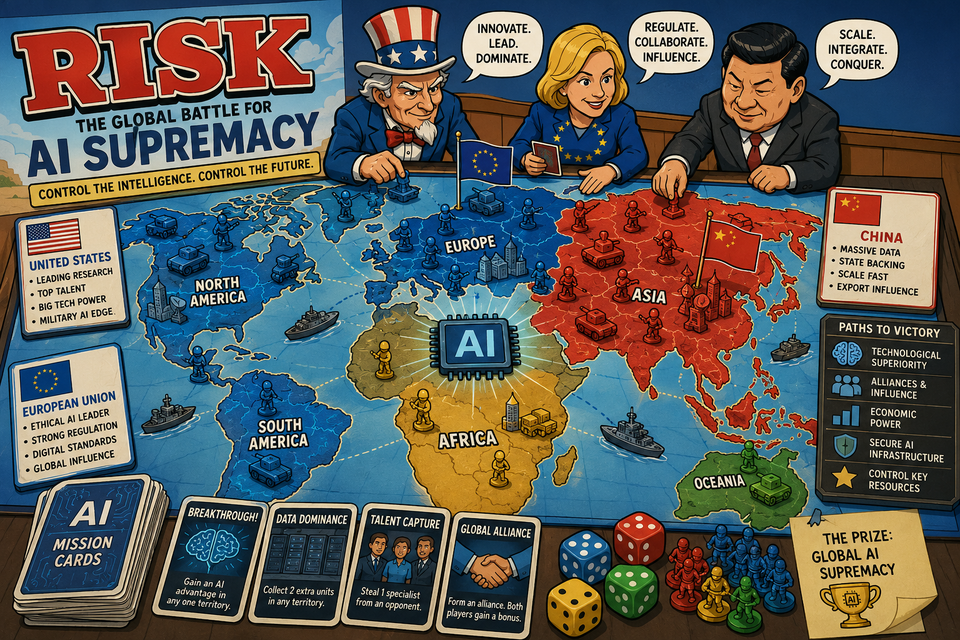
WELCOME TO THE FREE MONTHLY EDITION of Digital Politics. I'm Mark Scott, and many of you (I hope) are on vacation. A lot has happened so far in 2026. With the summer lull upon us, this week's edition is updating a piece that I wrote for POLITICO in 2024 about the global race to control artificial intelligence.
It's not a like-for-like comparison. Back then, I was a tech reporter. Now, I'm a think tanker (and newsletter writer.) But the underlying question — about who will control the emerging technology for years to come — has not changed.
If anything, it's become even more complex.
Let's get started:
TWO SUMMITS, DIFFERENT AGENDAS
ON A WET AFTERNOON IN LATE 2023, the likes of former US vice president Kamala Harris and then-senior Meta executive Nick Clegg trudged into a wind-swept tent an hour north of London. They had gathered to show a united front against what many feared would be a threat to the world: uncontrolled artificial intelligence. After late-night negotiations, the outcome was the Bletchley Declaration, a voluntary commitment by 28 countries, including the United States and China, to identify and respond to existential risks tied to the emerging technology.
Fast forward two years, and Narendra Modi, India's prime minister, stood in front of a podium in February to address thousands of conference attendees at a purpose-built convention center in New Delhi. His speech — translated simultaneously into 11 languages via AI — had followed announcements from Google, Tata and Anthropic about multi-billion dollar investments in India's fast-growing economy. The event's communiqué, signed by 92 countries and international bodies, only paid lip service to the safety concerns that had been central to the United Kingdom's inaugural AI summit.
Instead, the so-called AI Impact Summit in New Delhi was, above all, about the economic gain to be derived from the technology. "This is the fourth AI summit since Bletchley Park," Anthropic chief executive, Dario Amodei, told conference-goers. "We are increasingly close to a country of geniuses in a data center, systems more capable than most humans at most tasks."
What follows is an assessment of the global race for AI in 2026. It focuses on four themes that remain central to this geopolitical battle: 1) Who sets the rules?; 2) What do those rules look like?; 3) How corporate lobbying merged with countries' priorities; 4) How AI merged with national security.
These themes are obviously intertwined. But, above all, this update on the global race around AI tracks the rise of geopolitics, the disintegration of a Western consensus around AI safety/governance and a fundamental change in the global debate since officials first gathered at Bletchley Park in November 2023.
The splintering of AI-rulemaking
THERE WAS NEVER A WESTERN CONSENSUS for AI rule-making. Back in 2023-2024, the European Commission and former White House administration criss-crossed the globe to champion their respective visions of what AI oversight looked like. Washington preferred voluntary commitments. Brussels went all-in on its AI Act.
That basic tension is still there. Arguably, it's more pronounced in 2026. Where we are now (at least in terms of the European Union, US and China) is three competing sets of rules with no realistic "translation layer" to connect them. If the Bletchley Park Declaration, albeit voluntary, was about setting aside national interests to promote AI safety at a global level, then the current landscape is defined by fragmented national/regional rule-setting designed to favor individual strategic interests.
Here's what paid subscribers read in July:
— An inside look at how regulators and companies view digital rules differently; Why Europe's digital sovereignty ambitions are missing a critical element; Almost half of Americans use AI chatbots at work. More here.
— Platform governance has entered a new phase: redesigning social media; The United Nations' push into AI misses where the real decisions are made; People aren't relying on chatbots to access news. More here.
— An ongoing focus on digital foreign interference misses where the next online threats are coming from; How the US and China laid out AI governance plans that left everyone else in their wake; More than half of Americans now favor a social media ban for kids. More here.
— Brussels and Washington are a lot closer on digital competition than you may think; The United Kingdom again shows why it's a second-tier digital nation; Data to show why China and the US are so far ahead on AI. More here.
The US' subtle pivot is demonstrable of how things have changed. During Joe Biden's administration, Washington laid out plans (via White House Executive Order) that made clear US efforts to remain the global leader on AI. But it also included some safety provisions, including watermarking for AI content and protecting consumers from AI harm, that positioned Biden in a co-regulatory relationship with AI firms.
That Biden-era Executive Order was quickly scrapped. In its place, Donald Trump's administration initially doubled down on removing all forms of AI oversight in the name of promoting US dominance. That framing, however, has shifted in 2026 as US officials respond to growing national security concerns around both how powerful the latest AI models have become and how quickly China's open-source rivals have matched US tech firms' proprietary systems. Ironically, in imposing export controls on Anthropic's most-advanced model, the laissez-faire Trump Administration had more direct intervention than the Biden Administration — and its favoring of some regulation — ever did.
For Europe, there also has been an about-turn on what had been Brussels' clear policymaking objective: comprehensive AI rules.
It's not that the EU isn't still committed to its AI Act. Those rules — like everything in Brussels — will stick around no matter what. But the recent AI Omnibus delayed some of the regulatory deadlines associated with high-risk AI use cases. It also introduced a ban on AI tools that created non-consensual explicit images/deepfake content, in part to placate anger within the European Parliament for the wider delay in the comprehensive AI rulebook.
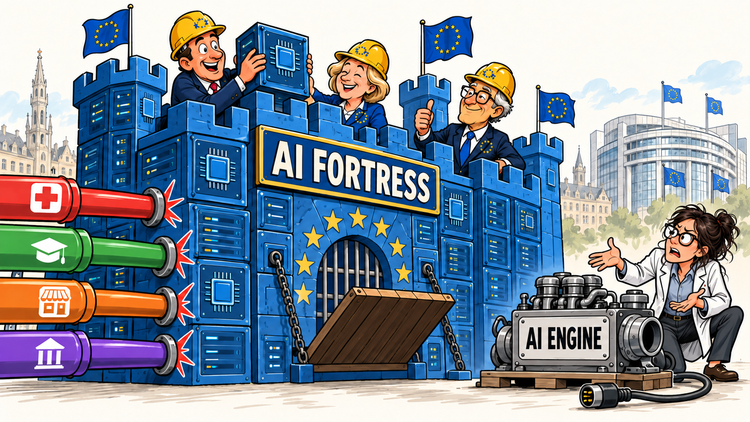
More importantly, Europe shifted gears from using regulation to police AI to passing rules to jumpstart AI-enabled economic growth. The bloc's recent European Technology Sovereignty Package is less about AI enforcement, and more about using public funds to build EU digital infrastructure and compute power to ward off the "kill switch" fear associated with the bloc's current reliance on US tech providers.
This change put Brussels directly at odds with Washington's "AI dominance" strategy in a way that escalates the previous tensions between the US and EU on who should set global AI standards.
I won't pretend to be an expert in China's domestic AI rulebook (more on that here, here and here). But its international priorities now match those of Beijing's similar approach to digital diplomacy: use its convening, financial and standards-setting muscle to nudge other (Global Majority) countries to back its more authoritarian take on the emerging technology.
Its recent creation of the so-called World Artificial Intelligence Cooperation Organization, based in Shanghai, is this "Belt and Road" philosophy tilted toward the AI age. It's nominally multilateral, with 28 countries joining the organization, and includes language around openness, equity and inclusiveness. But the geopolitical aim is clear: to export a China-focused regulatory and governance model for AI to position Beijing (and its world view) at the center of the global AI rule-making discussion.
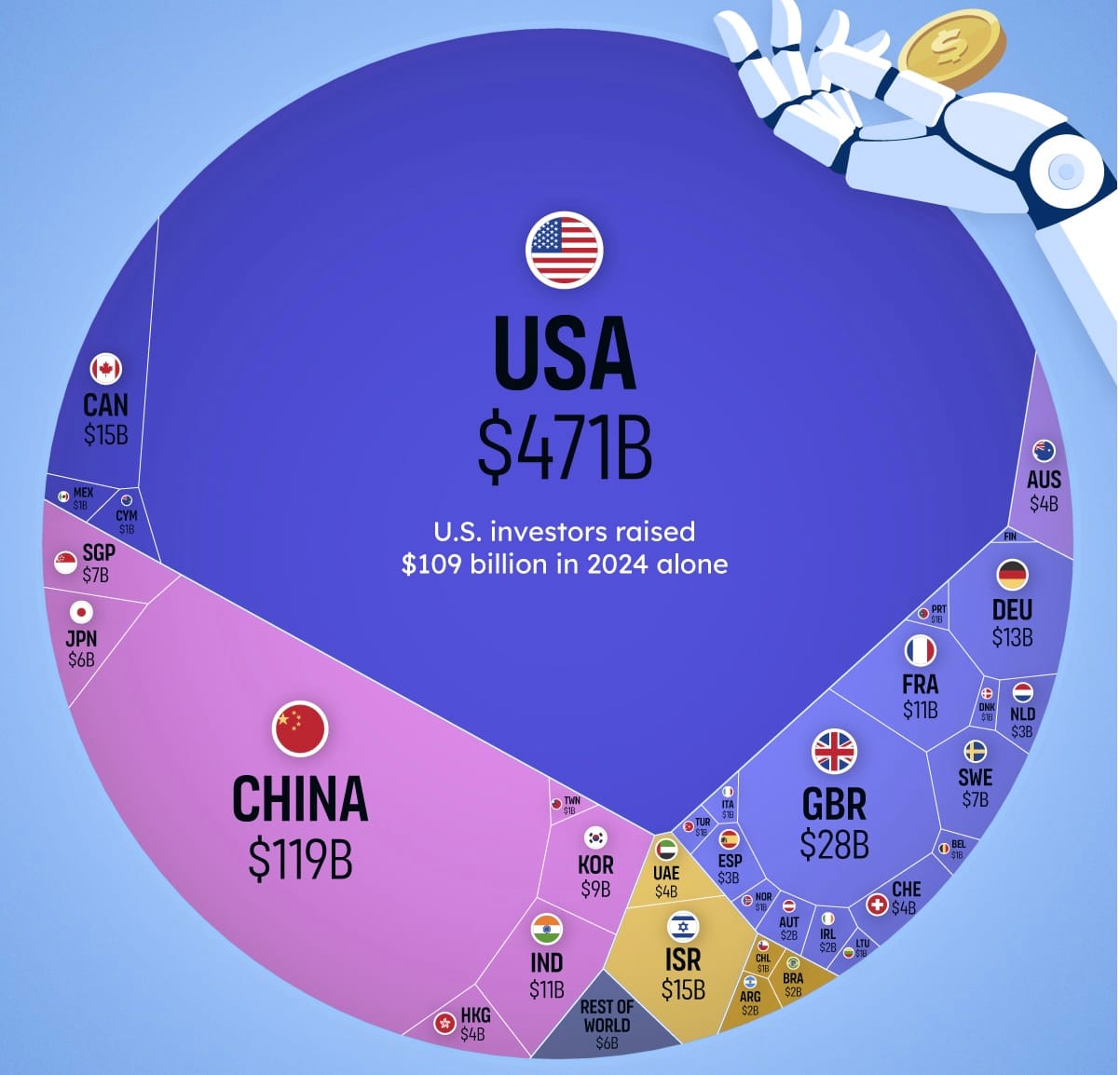
Chart of the Week:
Total combined investment between 2021-2024 for countries worldwide (with a minimum investment of $1 billion).
The scale of accumulated US and Chinese investment over the time period explains why AI rulemaking for those countries is now inseparable from states’ attempts to protect existing industrial advantages for strategic national gain.
Yes to regulation. Just make it my regulation.
THIS IS WHERE THINGS REALLY HAVE BECOME complex compared to where we stood in 2023/24. Back then, the battle centered on disputes about what regulation should do and who should be policed. Many of the largest US tech firms — the ones with the most advanced large language models — called for regulatory limits so only their systems could be used. That would be based on voluntary commitments to comply with oversight from a number of national AI safety institutes that had begun to sprout up.
The fear was that the alternative — framed via the expansion of open-source alternatives — would lead to short-term (AI's creation of bioweapons) and existential (read: Skynet) risks that were just too big to not be enforced by strict rules.
That dynamic continues in 2026, but with an even greater corporate bent. The likes of Google's DeepMind now actively call for greater regulation — albeit via an industry-funded self-regulatory agency akin to the US Financial Industry Regulatory Authority. OpenAI's Sam Altman has similarly suggested Washington lead efforts to create international certificates/standards for the latest large language models, again in a model that would massively favor that tech giant over smaller rivals.
Now, the regulatory discussion has become a geopolitical contest where each country's/region's approach and strategy is framed around promoting separate strategic interests. Regulation has become industrial policy by another name.
In the US, AI rules have now become OK, especially in light of the recent hacking efforts by OpenAI's systems and rumors about what Anthropic's latest models can do. Yet these proposals are inevitably self-serving. Companies propose oversight that will likely entrench their dominance by raising barriers around who can build such advanced AI systems. Call it regulatory capture framed as public safety.
The Chinese have thrown their full weight behind open source. In part, that is a pragmatic response to increasing US efforts to stop the world's second largest economy from accessing AI infrastructure like high-end semiconductors. But it's also a strategic play to reduce Beijing's (and other capitals') reliance on US proprietary models when much of the world's willingness to trust Washington has been diminished.
It helps that Chinese open source models are now mostly on par with those from Anthropic, Google and OpenAI. It also helps to position Beijing as a willing partner, see above section, with national capitals across the Global Majority which feel shut out from the conversations going on in Brussels and Washington, respectively. The fact that Western companies are now embracing such Chinese open source models is a sign that Beijing's tactics are bearing fruit, even across the US and Europe.
Europe, the OG of digital regulation, has been caught flat-footed by the "open versus closed" battle between the US and China. Part of that can be explained by the 27-country bloc's fixation on its digital sovereignty agenda that now includes pumping public money into "Made In Europe" digital infrastructure. That goal has been championed by the Continent's legacy industries.
The recently-published European Tech Sovereignty Package didn't go as far as many of these firms would have liked in terms of kicking US tech giants out of the bloc's digital infrastructure. It also embraced open source as a means to both reduce the EU's reliance on US tech providers and jumpstart AI-enabled economic growth, which — at least on paper — sounded awfully similar to what China is now promoting.
But Europe's rule-making, like that of the US and China, is now overwhelmingly positioned to support the Continent's industrial interests. Two years ago, that conversation was squarely focused on policing the emerging technology for public good.
The combination of lobbying and geopolitics
COMPANIES PUSHING THEIR CORPORATE INTERESTS is not new. And even in 2023/24, many of the arguments about whether regulation should favor either open or closed AI models were more akin to a lobbying fight between rival industrial camps.
Yet in 2026, the line between corporate lobbying and countries' geopolitical strategies has blurred into insignificance. With so much on the line when it comes to AI (in terms of economic growth and national security, see below), officials are now more willing to actively promote specific companies — both at home and abroad — to ensure their vision of the AI future comes to pass.
I've already outlined some of this in the section above. But when Anthropic's chief executive outlines his concerns about the Chinese Communist Party developing AI models that are "more powerful than those built by the US, and use them to achieve permanent military superiority," the distinction between what are corporate and national priorities becomes hard to disentangle.
There is a reason why some within US tech circles now refer to Chinese rival AI models as "Communist AI," and it's not because of legitimate concerns about how the authoritarian regime could potentially use such advanced technologies. It plays directly into Washington's mounting fears of Beijing's technological prowess, and turns corporate concerns about being supplanted by cheaper, Chinese open source competitors into national security concerns that, potentially, may lead to action by the US Congress or White House.
It's not like the Chinese are not doing something similar with their embrace of open source. They decided that competing head-on with the likes of OpenAI and Google was a mug's game. A lack of access to high-end Nvidia chips and semiconductor technology from the likes of the Netherlands' ASML also forced their hand. But Beijing's interests now align with Chinese companies' interests: build globally-competitive open-source models that reduce the ability of US rivals to sell their wares to would-be clients worldwide.
The European lobbying is equally grounded in policymaking priorities, albeit Brussels is somewhat more navel-gazing than either Washington and Beijing. EU companies have successfully (and possibly legitimately) framed the bloc's ongoing use of US technology as a strategic dependency that now must end. Europe's willingness to use public funds to build up its own digital infrastructure — often via contracts to these very same European companies — brings those corporate interests and policymaking goals full circle.
What no one (or, almost no one) is willing to admit in the EU is that, currently and likely for the foreseeable future, European alternatives are not yet ready to compete, at scale, with incumbent US tech providers. Many in Brussels know that reality. Few are willing to say it out loud.
New dynamic: AI = national security
WHEN I REPORTED THE POLITICO ARTICLE in 2023/24, national security was an also-ran in the AI governance conversation. There were concerns around how the technology would be used in autonomous weapons. But questions around AI safety and "trustworthiness" were central to global AI policymaking discussions.
How much can change in two years.
Alongside a focus on AI-enabled economic growth, the merging of artificial intelligence with national security priorities has become the only digital policymaking game in town. Well, that and kids' social media bans. Many of the AI safety institutes created in the wake of the Bletchley Park Declaration even renamed themselves "security" institutes (looking at you, United Kingdom.)
There are good reasons for this shift. The latest AI models are breaking things that many thought unthinkable, even a year ago. The use of AI in warfare is now worryingly routine.
The ability of governments (aka Washington) to impose export bans on advanced large language models, as well as stop other countries from accessing high-end chips, is now accepted, even if opposed by the likes of China that face such restrictions. There are some in the US who now even want to ban Chinese open-source models from entering the country.
Where once AI governance was framed through the prism of traditional digital regulation, it is now conducted via such export controls, model restrictions and investment screenings directly in the wheelhouse of national security.
In truth, national security has now consumed the other areas of the global AI race that were so prominent in 2023/24. Rules are set to meet national security objectives. Regulation is constructed to promote national strategic advantages. Corporate lobbying is positioned through a geopolitical lens, and not as one that pits companies and governments on separate sides of the table.
That is the biggest fundamental shift — and speaks to the geopolitical nature of the global AI race that, while present in 2023/24, has been turned up to 11 over two years later.
In 2024, I asked who would control AI. The answer in 2026 is that control itself has become the objective. Each jurisdiction is building the AI infrastructure, the regulatory framework and the corporate alliances to try to control the emerging technology, and not be controlled by it.

Member discussion