Digital Politics at 100: What I got wrong

WELCOME BACK. THIS IS THE FREE MONTHLY EDITION of Digital Politics. I'm Mark Scott, and will be speaking at an online event about social media data access and attacks on independent research, organized by Columbia World Projects, the Centre for Digital Governance at the Hertie School and Tech Policy Press. It's at 16:00 CET / 10:00 ET on June 18. You can register here.
This week's edition marks Digital Politics' 100th newsletter. That's just under 260,000 words over 22 months on everything from Europe's stuttering digital rulebook to the United States' quixotic take on tech to the rise of the Middle Powers movement.
Not everything I've written stood the test of time. So I went back over the last two years to figure out what I got wrong, and why. Call it a mea culpa. Digital policymaking moves fast and the geopolitics have only grown more complex since 2024.
Thank you for reading along the way. I started this newsletter to understand what was going on around me. I find these dispatches a useful way of framing my thinking. I hope you also find it useful.
If you've been reading for free and have been considering whether to support the newsletter, you can subscribe here.
Let's get started:
Move over digital cold war. Say hello to G2 frenemies
DONALD TRUMP HAD YET TO WIN THE White House when I started writing Digital Politics. But shortly after his victory in November, 2024, I laid out what I thought would be a digital policymaking slam dunk. Just like his first term, the newly-elected president would take an aggressively hawkish view on China. That would include the extension of tech-related export controls and other trade barriers to stop the world's second largest economy from dominating the era of artificial intelligence, electric vehicles and quantum computing.
All other countries — most notably the so-called Middle Powers like Brazil, South Korea and the United Kingdom — would have to figure out how to balance the United States' expected harsh treatment of its geopolitical foe with their own needs to engage directly with China.
Fast forward to the middle of 2026, and the picture is more nuanced than I had expected.
The aggressive stance of the Trump 1.0 administration has softened into a more transactional approach to Beijing. Under direct pleas from Nvidia, Washington allowed the American chip giant to ship some of its most advanced semiconductors to China — although that has stalled due to American bureaucracy and a growing aversion in the Middle Kingdom toward relying on US-made chips. The US and China also mulled greater cooperation on AI governance during Trump's visit to Beijing last month, though details of what that would actually look like remain unclear.
"Relations between the United States and China are better than they’ve been in many years," Pete Hegseth, the US Secretary of Defense, told an audience in Singapore on May 30.
Well, possibly. A day after Hegseth's comments, a unit within the US Commerce Department issued guidance that closed a potential loophole that could have allowed high-end tech, including Nvidia's semiconductors, from being sold to subsidiaries of Chinese firms located outside the country. It's hard not to see that as hawkish parts of the US government holding the line — just like in the Trump 1.0 administration — against any rapprochement between Washington and Beijing.
Confused? Yeah, me too. What I thought would be a binary 'digital Cold War' between the world's two largest economies has morphed into something more complex. It's a whipsawing relationship that mixes genteel diplomacy, economic realpolitik and more mutually-reinforcing ties on tech than could have been expected 18 months ago.
That has knock-on consequences for Middle Powers. If we were living in a binary world in which the US took an overtly hostile position to China (and ongoing friendly relations with long-standing allies), then there could be a consensus between democratic countries about the need to push back against Beijing.
We do not live in that world. So far this year, more than 20 national leaders or countries' heads of state have visited China as states from Canada to Serbia figure out the new G2 dynamic. Sure, many of these same domestic politicians have also visited the US. But just as relations between Beijing and Washington have become messy, so too have diplomatic ties between other countries and the world's remaining superpowers.
My initial digital Cold War framing was wrong not because Washington and Beijing are now besties. It was wrong because I had assumed a level of joined-up thinking from American policymakers toward China that didn't pan out. Call it a managed incoherence — something that is significantly harder for Middle Powers to navigate.
Here's what paid subscribers read in May:
— The protection for children online runs counter to long-standing fundamental privacy rights; the use of AI to profile voters, not to create deepfakes, is the greatest challenge to the US mid-terms; Half of Americans polled are worried about AI. More here.
— I crunched the numbers on how much sovereign AI would actually cost; Why digital antitrust efforts have not hobbled online advertising dominance; Spending on government AI systems will hit $80 billion in 2026. More here.
— The UK's political implosion is an apt metaphor for its flagging digital policymaking; Middle Power countries are finding their feet in the new "G2 era;" AI giants are massively subsidizing their consumer-focused products. More here.
— Everything you need to know about the European Tech Sovereignty proposals; The pros and cons of Europe's social media accountability efforts; Internet shut-downs have risen four-fold in a decade. More here.
Countries just can't stop with social media bans
I DO NOT LIKE SOCIAL MEDIA BANS. To be honest, I'm not a big fan of banning outright. There's almost no evidence that such moratoriums lead to the results that politicians and policymakers are looking for. The proposals are often caught up in parents' legitimate concerns about protecting their child from online harm. The fact that we are even contemplating these moves is a black mark against global platforms which have repeatedly refused to open themselves up to independent scrutiny.
Where I went wrong (again and again) was assuming that national officials and lawmakers would either review the existing literature on banning social media for minors, or wait for the ongoing trial in Australia to show results (or not) before making their own judgements about cutting off teenagers from the likes of TikTok and Instagram.
More fool on me.
By the end of the year, expect a number of countries, including the UK and those within the European Union, to either have implemented nationwide bans or outlined proposals about how such initiatives will be phased in over the next 18 months. In an era of FOMO, kids' social media bans have become the digital policy that no country's leader wants to miss out on.
Some of this is down to pure politics. No politician is ever going to lose an election by telling would-be voters that her aim is to protect children. It also highlights how the political mood music has turned against social media giants — even when these platforms are still readily used by the same lawmakers to reach the electorate ahead of domestic votes.
Some of this is down to policymakers having few meaningful levers to quell the growing amount of online harm that bombards us all online. Countries' ongoing attempts at policing social media are more philosophical than practical (despite the growing list of enforcement actions.) Some platforms — at least those from the US — have embraced a 'free speech' ethos that has made their interactions with regulators increasingly adversarial.
Either way, I underestimated the political stickiness of a digital policy that is not grounded in quantifiable evidence. The honest truth is that when parents are scared and platforms no longer have credibility, such evidence no longer matters — and the social media bans start appearing.
The era of AI regulation is not over
I HAVE A BIAS TOWARD WESTERN DIGITAL POLICYMAKING. I spend much of my time trying to understand the inner workings of what's happening in Brussels, London, Washington, etc. In those capitals, the shift away from hard-nosed rules toward artificial intelligence is pronounced. We are in an era of AI-driven economic growth and competitiveness. Within that landscape, AI rulemaking has taken a back seat.
But what I missed over the last two years was a growing stable of AI legislation from countries outside of this Western-centric world view. That was a significant own goal at a time when everyone and their grandmother wanted to know what was happening with AI.
This AI policymaking has taken on various shades depending on where you look.
Brazil offers the most like-for-like comparison to what the EU has just rolled back on via its Digital Omnibus package. In Latin America's most populous country, the proposals include a risk-based approach akin to what Brussels has envisioned. That includes corporate risk assessments and a combination of regulators to oversee different AI use cases. Still, it has yet to be enacted.
Japan has gone a different route. Tokyo preferred a more innovation-friendly approach that involved public funds for AI research, co-regulation with companies and voluntary guidelines over mandatory restrictions. There are no potential fines for wrongdoing. Instead, regulators can issue guidance, request information from companies and shame firms that do not comply.
Singapore, again, has charted its own path. The small Asian country views its domestic AI rules through the prism of export and trade. It announced a world-first governance framework for agentic AI and is now working on interoperability standards which would position the country as the go-to standards setter.
Many may argue these proposals are less rule-making and more voluntary guidelines. Fair point. But the geographical scope of AI governance — and in this analysis, I didn't include what's going on in India and parts of Africa — is a trend that I underestimated. Just because Western countries are pressing pause on the AI legislation button does not mean other parts of the world are willing to wait around.
For sure, AI rulemaking is not thriving globally. But a purely Western frame is no longer sufficient to understand where AI governance is actually heading.
Chart of the week
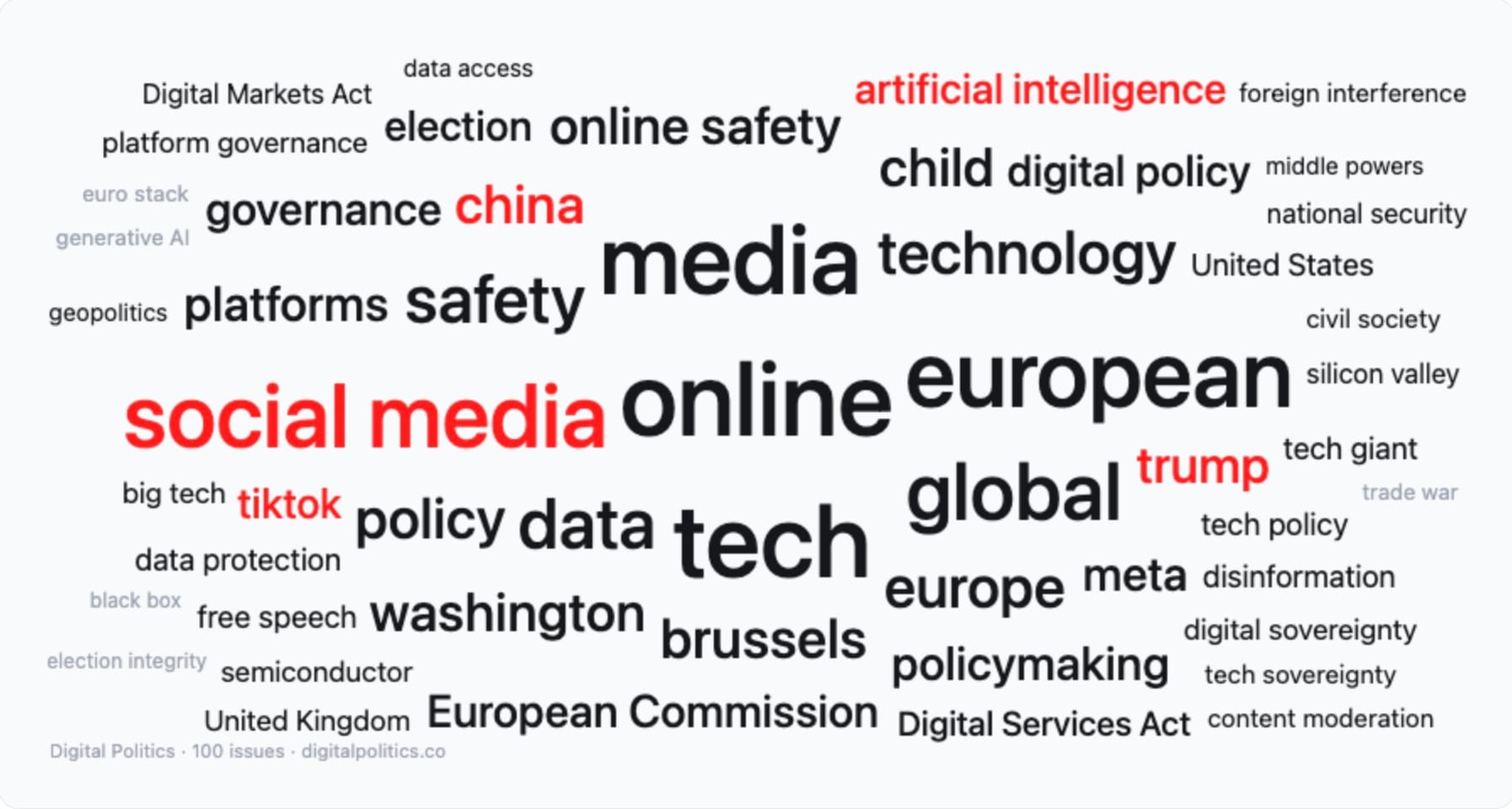
MY BRAIN WORKS IN IMAGES, NOT WORDS. So I used Anthropic's Claude to produce a chart of the most commonly-used phrases over the first 100 editions of Digital Politics to figure out what were the main themes over the last 22 months.
Not surprisingly, topics like social media and artificial intelligence get a lot of play. So too did politically-sensitive themes and people like the Digital Services Act and Donald Trump.
What did actually happen in Romania?
I WOULD NEVER PRETEND TO BE AN EXPERT on Romanian politics. But when far-right politician Călin Georgescu won the first round of the country's presidential election in late 2024 — and Romania's constitutional court annulled his victory after irregular social media activity on TikTok — I took a stab at what was going on.
My main point: national policymakers and the European Commission were getting over their skis by accusing social media of swaying the election in favor of Georgescu, and that accusations Russia played a direct role in that online activity had yet to be proved.
I was wrong, to a degree.
The role that TikTok played in the presidential election's first round has yet to be proved. Despite a lot of fanfare from Brussels that it had started an investigation into TikTok's potential role, no public assessment — roughly 18 months after the fact — has yet to be published. EU officials rushed headlong into a national political mess, and incorrectly used the bloc's Digital Services Act as a tool to "fix" whatever had just happened in the European country.
But where I misjudged was the level of both social media activity and Russian involvement in what turned out to be a litmus test for Romania's commitment to its EU membership. FWIW, pro-Western politician Nicusor Dan eventually won the Romanian presidency in May, 2025.
Yet last year, TikTok admitted a network of 27,200 accounts, which operated through a fake engagement middle-man, attempted to promote a far-right political party and independent candidate Georgescu by posting comments on the platform at a mass scale. It's hard not to see that anything other than a wholesale attempt to use social media to sway the election — albeit how successful this covert network was is still debatable.
The links to Russia are also more likely than I had initially thought. Romania's national security agencies declassified documents that revealed a sophisticated TikTok operation that involved reams of accounts — which had been dormant for years — suddenly posting like crazy weeks before the 2024 first round election. These tactics, according to the country's spooks, were prime evidence of a coordinated effort by a foreign adversarial country (though they did not name Russia.)
Elections are always messy. So, too, is analysis trying to figure out what happened, in almost real time. What I missed was the level of sophistication of the covert operation to support Georgescu's campaign via TikTok — and its likely ties to the Kremlin.
The Brits don't know what they are doing on digital policy
THIS ONE SITS CLOSE TO HOME. As someone who has watched consecutive British governments try to articulate a vision toward technology over the last decade, the subsequent inertia — on everything from online harms to artificial intelligence to data protection reform — has been hard to swallow. I may not always agree with what Brussels and Washington do on digital policy. But at least I can see a somewhat coherent argument about how they go about their business.
Not so for London.
In early 2025, I laid out what could be the UK's post-Brexit dividend toward tech. It included a doubling down on the country's existing digital rulebook as a means of making it the global centerpoint for so-called "RegTech" (that position has now been taken by Singapore.) It included a revamping of the UK's financial services sector and public funding options to support the country's leading tech industry. It included a plea for London not to blow hot-and-cold on digital rule-making amid a generational shift in geopolitics.
Looking back, none of these proposals landed. That's not surprising. The UK's ruling Labour Party finds itself amid a likely leadership challenge. The country's tech sector remains Europe's largest — although most of its firms eventually go public in the US or are bought by American rivals. Any form of Brexit dividend, in terms of using the country's digital rules as a differentiator in the global tech race, has been in short supply.
These recommendations still hold true. What I misjudged was the political inertia that has made the UK an also-ran in the global digital policymaking discussion. It's hard to articulate what London stands for on tech — other than wanting to both entice foreign firms to set up shop locally and create populist digital rules like a potential social media ban for kids.
This is not a party political criticism. The same woes confronted previously Conservative Party administrations. The UK is still stuck in the middle ground and lacks a vision for digital policymaking. I offered suggestions on how to fix that. Politicians had other ideas.
What I'm reading
— The Knight Georgetown Institute assessed how individual governments were implementing age assurance and how each proposal stacked up against the others. More here.
— The G7 countries agreed to voluntary commitments on how to protect children online. More here.
— The European Commission published draft guidelines for so-called "trusted flaggers," or independent groups that can raise issues with online content to regulators. More here.
— Softbank announced it would invest up to $87 billion in data center infrastructure in France. More here.
— The Pope laid out his concerns about artificial intelligence. More here.



Member discussion